OBD connectors, cable connector, obd 2 scanner, car scanner, obd device

What Is the OBD-II Port and What Is It Used For?
Assuming you bought a vehicle after 1996, it likely has an OBD-II
port. Yet, what is it for, and how would you determine blunders to have it?
Assuming you bought a vehicle after 1996, odds are it has an OBD-II
(On-board diagnostics II) port. Each vehicle or truck out and about fabricated
after 1996 is lawfully ordered to have one introduced.
OBD-II is an on-board PC that screens discharges, mileage, speed,
and different information about your vehicle. It's associated with the Check
Engine light, which enlightens when the PC distinguishes an issue.
The OBD-II on-board PC includes a 16-pin port situated under the
driver's side scramble. It permits a repairman or any other individual to peruse
the blunder code utilizing a unique sweep device.
OBD-I versus OBD-II
Before OBD-I, every maker had their own arrangement of norms for
OBD, implying that repairmen needed to purchase costly sweep devices for every
producer. OBD-I was first presented in 1987, and began the normalization of
installed diagnostics.
It had sensors that identified discharges and had the option to
limit them through emanations controlling valves. Notwithstanding, it had
numerous issues and deficits.
Subsequently, in 1996 vehicle makers began to furnish vehicles and
trucks with an OBD-II port. Each framework is for the most part something very
similar, yet there are slight varieties. These are known as conventions, and
are intended for vehicle makers.
When the PC detects an issue with the motor or some other part of
the vehicle it's observing, it'll set off the Check Engine light. A few
vehicles additionally flicker the motor light on the off chance that the issue
is an intense one.
How Does OBD-II Work?
Demonstrative Trouble Codes (DTC) are put away in the PC framework.
Codes can differ starting with one maker then onto the next. In any case,
anybody with an OBD-II output instrument can interface with the port and read
the demonstrative difficulty codes from the PC.
The explanation any OBD-II sweep device can peruse the codes is a
direct result of the normalized pinout. Filter apparatuses can peruse from any
of the conventions recorded previously. The normalized pinout is as per the
following.
Pin 1: Used by maker
Pin 2: Used by SAE J1850 PWM and VPW
Pin 3: Used by producer
Pin 4: Ground
Pin 5: Ground
Pin 6: Used by ISO 15765-4 CAN
Pin 7: The K-Line of ISO 9141-2 and ISO 14230-4
Pin 10: Used simply by SAE J1850 PWM
Pin 14: Used by ISO 15765-4 CAN
Pin 15: The K-Line of ISO 9141-2 and ISO 14230-4
Pin 16: Power from the vehicle battery
OBD-II scanners can associate with these ports and recognize the
difficulty code from any producer that utilizes one of the OBD-II conventions.
What Can Be Hooked Up to the OBD-II Port?
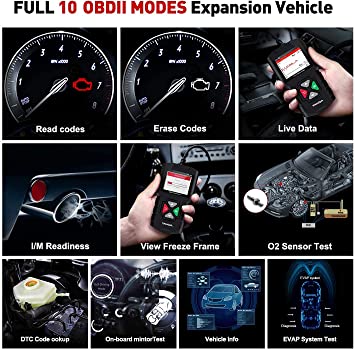
Generally, a technician would attach an output device to the port to
peruse the DTC. More affordable scanners would just give a numeric code, which
the repairman would then gaze upward from the maker's manual or administration
site. More costly scanners give will give text mistake codes.
Be that as it may, lately, there are further developed instruments
accessible for customary drivers who would rather not need to rely upon a
specialist to find oBluetooth-empowered, and works with both Android and iOS
gadgets.
It's fairly more costly than other remote port-perusers available.
Nonetheless, it comes the kind of elements you'd anticipate from a similar
costly output instruments that specialists use.
The gadget allows you to utilize your portable application to peruse
and clear both essential and high level blunder codes. It likewise incorporates
advance tests like discharge failure counts, live information as computerized
readouts and diagrams, and even fix reports from an every now and again refreshed
internet based data set.
Automa ut what's going on with their vehicle.
One model is the OBDLink SX USB Adapter by ScanTool that allows you
to peruse the difficulty codes with your PC.
This gadget allows you to plug straightforwardly into the OBD-II
port, and attachment the opposite end into the USB port of your Windows PC.
This changes your PC into a high level OBD scanner instrument, in
addition to you could in fact clear the Check Engine light with the OBDwiz
diagnostics programming.
Assuming you lean toward a remote arrangement, ScanTool additionally
offers OBDLink MX Bluetooth.
This gadget allows you to peruse your vehicle diagnostics with your
Windows blue-tooth empowered PC, or your Android gadget.
It accompanies free Windows and Android programming to remotely
analyze your vehicle.
Other Mobile OBD-II Scanner Apps
The PC framework in your vehicle is continually checking different
frameworks and parts all through your vehicle.
This implies that any gadget that plugs into the port can peruse a
similar data and give it to your cell phone. Envision opening an application on
your telephone and review your vehicle's ongoing fuel utilization,
temperatures, oil tensions, and that's just the beginning.
It's one of the more costly choices, however the elements are
absolutely astounding.
3G network gives far off vehicle data regardless of where you are.
Get continuous vehicle information in any event, when you're a long
way from your vehicle.
Identifies crashes and sends crisis administrations to help you.
Coordinates with the Echo, Nest, and IFTTT.
GPS following empowered so you generally know the area of your
vehicle.
While the cost sets this cutting-edge check device inside the scope
of numerous costly mechanics use, these amazing highlights make it definitely
worth the expense.
Exploiting Your OBD-II Port
The OBD-II port has been accessible in vehicles for a
long time, however as of late has been open to standard drivers. Having these
gadgets and applications gives you much better understanding into what's the
deal with your vehicle, some time before any serious issues at any point
happen.


Comments
Post a Comment